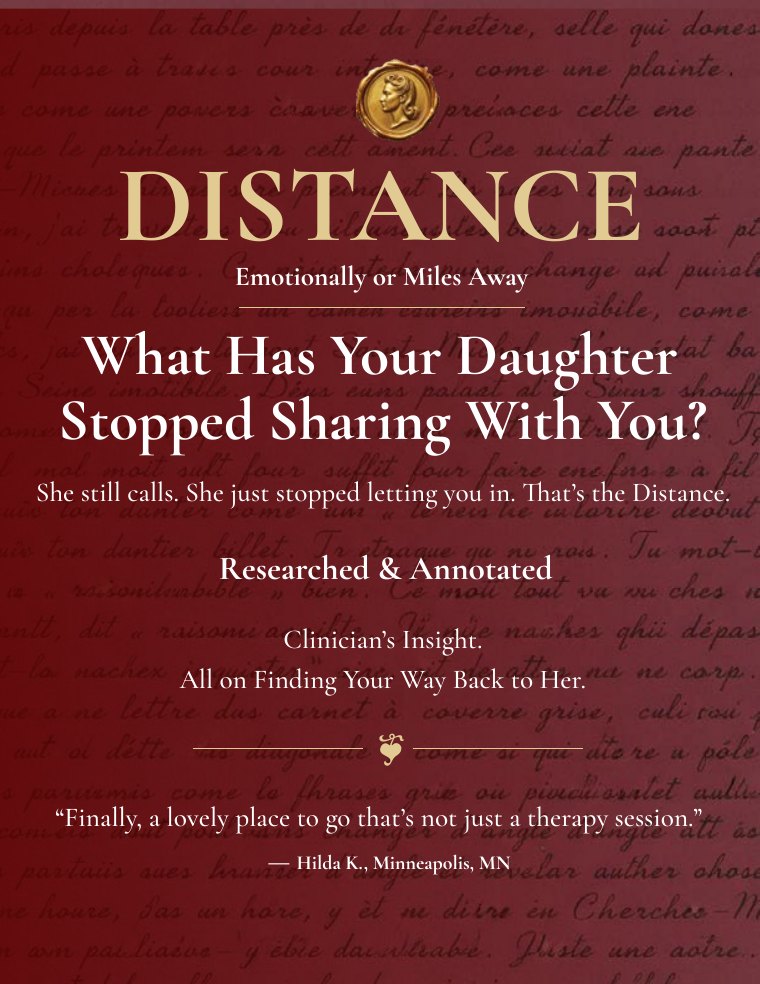
Why Adult Daughters Pull Away: A Clinician’s Guide to the Quiet Distance
The distance rarely begins with a fight. Ask a mother when it started and she will often struggle to name a date, because there is no date — there is a drift. The calls became shorter. The replies became politer. The visits still happened, but something in the room did not. If this is your situation, the first thing to know is that you are describing one of the most common and least discussed patterns in modern family life — and that the silence you are living inside has a structure. Structures can be understood. What can be understood can be answered.
The distance is common — and commonly hidden
Research at Cornell University led by Dr. Karl Pillemer found that roughly one in four Americans lives with an active estrangement from a family member — and that figure counts only the ruptures people are willing to name. The quiet version, the one with no announcement and no argument, is far more widespread and almost never reported, because there is nothing official to report. She still answers. She still comes to holidays. The relationship has not ended; it has thinned.
Mothers in this season tend to believe they are alone in it, because nobody brings it up at church or at book club. The clinical literature calls the grief of it disenfranchised — a loss that society does not recognize, and therefore does not gather around. Understanding that the pattern is common does not lessen its ache, but it dissolves the most corrosive belief attached to it: that this happened because something is uniquely wrong with you or with her.
Here is the cruelty of the quiet distance: the responses that feel most natural to a mother — reaching out more often, asking what is wrong, reminding her daughter of all that was given — are the three moves the clinical literature most associates with acceleration. The instinct to close the gap is precisely what widens it. This is not a failure of love. It is a failure of vantage: the pattern cannot be read by the person standing inside it.
Some of the distance is developmental, and a mother is right to say so. But the developmental story carries a quiet expiration date: individuation loosens the daily thread — it does not shorten the calls that still happen, or hollow out the visits that still occur. When a mother says phase, she is often describing the first year of something that is not one.
Why daughters, particularly
Family researchers describe daughters as the traditional kin-keepers — the ones who remember the birthdays, arrange the gatherings, and carry the emotional bookkeeping of a family. That is exactly why a daughter’s distance registers so seismically: when the kin-keeper steps back, the family’s connective tissue steps back with her. It is also why her distance is rarely careless. Daughters who thin the connection have usually spent years managing it first. The stepping-back is not the absence of effort; very often it is the exhaustion of it.
What the distance usually means
Dr. Joshua Coleman, the psychologist whose clinical work centers on parental estrangement, makes an observation that reorders everything for most mothers: adult children rarely step back because they stopped loving their parents. They step back because contact, as currently conducted, costs them something — and they have not found the words to renegotiate the terms. The daughter’s silence is very rarely a verdict on your worth. It is far more often a boundary drawn by someone who does not yet have the language for a better one.
The silence is a language. It is simply not one anyone taught either of you to read.
This is why the standard advice — give her space, she’ll come around — so often fails. Space is not neutral. In the absence of contact, each side fills the silence with a story about the other, and the stories harden. Pillemer’s reconciliation research found that repair is more possible than most families believe, and that what prevents it is rarely the original wound; it is shame, entrenched narratives, and the absence of a workable first sentence.
The three patterns beneath the quiet
The inherited script. Much of what passes between a mother and daughter was written a generation earlier. Family answers when family calls. We don’t speak of such things. Longitudinal research suggests that a large majority of children adopt their parents’ conflict style by early adulthood — which means the very pattern producing the distance may be the one you each inherited, running on both sides of the silence at once. Naming the script is the beginning of setting it down.
The message beneath the message. Short replies are not empty; they are compressed. “I’m fine” and “busy, sorry” carry information about capacity, guardedness, and what a fuller answer would cost. Learning to answer the message beneath the message — rather than the words on its surface — is the single most learnable skill in relational repair.
The real-time problem. Live contact — the ringing phone, the unannounced question — activates the nervous system before a single word is exchanged. This is why letters, and slower forms generally, so often succeed where calls fail: the slower medium lowers the guard on both ends. It is not a coincidence that families separated by the upheavals of the 1940s found their way back to each other by post. The form itself was doing clinical work.
What to do with this
Not more messages, and not indefinite silence — but a different kind of message, timed and worded for the nervous system that will receive it. That is a precise practice, and it is exactly the practice the Clinician’s Desk can guide: reading the particular signals your daughter is sending, and giving you the next words — while she is still answering.
Annotation I — from the files
The ordinary word — present in most mothers’ messages — that the files show arriving as pressure, not affection. And what mothers who found their way back did instead.
Begin with the nine questions.
A short, private assessment. A personally prepared Distance Reading, and an answer to your own question from the Clinician’s Desk — within a day.
Citizenshare offers Bibliotherapy Lineage education — not therapy or clinical bibliotherapy — literary preparation and relational systems, informed and reviewed by a U.S. trained clinician. It does not provide psychotherapy, counseling, diagnosis, or medical treatment. Participation does not create a clinician–patient relationship and does not replace individual care from a mental health professional. If you are in crisis in the United States, call or text 988, or call 911.