Common Questions
Last updated: August 4, 2026
What is the Distance Reading?
A personally prepared, clinician-reviewed reading on your season of mother–daughter distance, based on your seven assessment answers — delivered to your inbox within a day. A Reading is preparation: when the moment to speak comes, you will not arrive as the same mother who last tried. Preparation for the next conversation your family needs — before it happens.
How does a mother find the way back — before silence hardens?
Through study and access to an experienced clinician. Citizenshare is an educational publishing house, and the Papers are its practice — a correspondence curated and sequenced to teach the language of repair while the channel is still open. The method has a lineage: bibliotherapy — the guided use of reading in learning and recovery — is a field with decades of clinical study behind it. One finding runs through that literature — guided reading outperforms reading alone. That is why the House pairs the Papers with a clinician rather than sending you a book. Bibliotherapy Lineage education, not psychotherapy.
Wasn’t 1947 a long time ago?
The tools of distance change. Its grammar never has. The unanswered letter became the unanswered text; the visit not returned became the block. Miriam faced the same silence — she just faced it on paper. History repeats; our clinician and archive are how we read it before crisis arrives.
Who sits at the Desk?
The Clinician’s Desk is the review body behind every Citizenshare reading. Its coaching is informed and reviewed by a clinician, and its readings apply the Almada Method — drawn from the Almada Papers — alongside established research on mother–daughter distance. The Desk prepares readings and answers the questions that arrive. It does not treat, diagnose, or counsel.
Who prepares my reading?
Every reading is prepared under the counsel of the Clinician’s Desk, which also answers the questions that arrive.
Is this therapy?
No. The Citizenshare offers Bibliotherapy Lineage education — not therapy or clinical bibliotherapy — literary preparation and relational systems, informed and reviewed by a U.S. trained clinician. It does not provide psychotherapy, counseling, diagnosis, or medical treatment. Participation does not create a clinician–patient relationship and does not replace individual care from a mental health professional. If you are in crisis in the United States, call or text 988, or call 911.
Does Citizenshare work with insurance companies?
No. Citizenshare is an educational publishing house, not a medical provider. We do not diagnose conditions, create medical records, or accept insurance.
Before there were waiting rooms and telehealth, families of social standing turned to Correspondence Counsel — letters, literature, and retained learned advisors known quietly, without media fanfare, as Readers; in Italian, Lettori.
They still do.
What does it cost?
The assessment, your Distance Reading, and one answered question from the Clinician’s Desk are our introduction to the house — offered without charge.
When will I hear back?
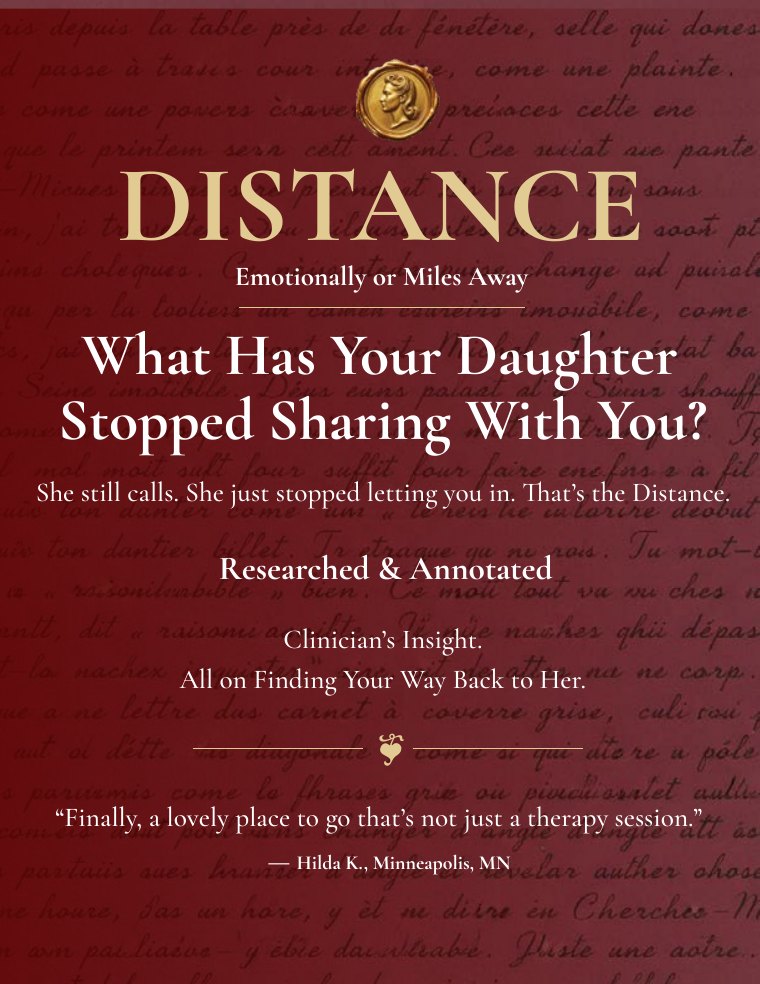
Your clinician’s answer arrives within a day, together with your first reading, What Your Daughter Stopped Sharing. Your second reading — the 1947 issue of Distance — follows.
Is my information private?
Yes. Your answers are used only to prepare your reading. We never share or sell your information. See our Privacy Policy.
Privacy is something the house takes seriously — here it means more than data. No office visits, no insurance records, no chance encounters. What happens in your correspondence stays between you, the clinician, and the page.
Can I give this as a gift?
Yes — write to us through the Contact page and choose "Gift" as your subject, and we will arrange it.
What is Miriam’s Scarlet Season?
Our flagship work: a daughter’s twenty-three-month correspondence from Venice to her mother in Lisbon — presented as literature, annotated as insight. It is the archive from which your readings draw.